Contradictions, numbers that don’t add up, claims your results never show, sentences that say the same thing twice: the mistakes that get papers sent back. Each one quoted from your own page, with a suggested fix. Done in about two minutes.*
First check freeNo account neededPDF, as you would submit it
*For an 8 to 15 page paper. Time grows with length: plan on several minutes for a paper over 50 pages, and keep the tab open.
On published preprints
Seven of the things it found in 65 arXiv papers.
We ran 65 arXiv papers from eight archives (cs, econ, hep-ex, astro-ph, q-bio, eess, math, nucl-ex) through the same check you get, several of them since published at CVPR, ICML and ICLR. Unedited output; every crop is the paper’s own page. Papers are not named.
65 papers · 1 663 pages · 1 013 things to fix, 475 to polish
Must fixp.15 · p.16
Figure 4a says “Simulations Run: 2 × 5 × 8 = 405”. Two pages earlier the prose gets it right: 2 × 5 × 8 = 80. The 405 was copied from an earlier figure.
The paper names four organs: liver, colon, pancreas, lung. The next sentence counts three of them and then “a total of 281”, but 131 + 64 + 126 is already 321. The pancreas count is missing; in that dataset the pancreas set has 281 volumes.
p.3
Suggested fixAdd the pancreas count and recompute the total, or drop the word ‘total’.
The text says the proposed method “significantly outperforms” the baseline “in every category”. In the table it cites, the baseline wins one category, 0.91 to 0.85.
p.17p.17
Suggested fixSay ‘in 9 of 10 categories on image fidelity, and in every category on mean distance’.
Computer vision · CVPR 2024, highlight · 17 pages
Must fixp.6 · p.11
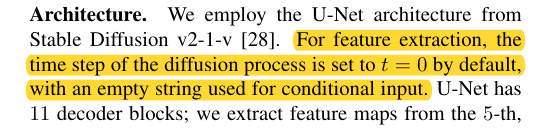
The method section says the diffusion time step “is set to t = 0 by default”. The ablation five pages later says the optimal performance is at t = 200, and the main results use it.
p.6p.11
Suggested fixState the value the reported results actually use.
Computer vision · CVPR 2024 · 14 pages
Must fixp.2 · p.8
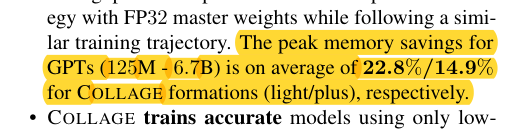
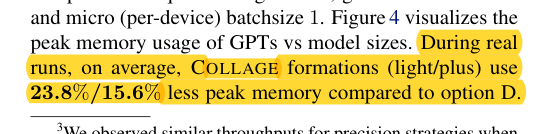
The contributions list peak memory savings of 22.8% / 14.9% against the FP32-master-weights baseline. The results section, measuring the same models against the same baseline (option D), reports 23.8% / 15.6%.
p.2p.8
Suggested fixUse the results-section numbers in the contributions.
Machine learning · ICML 2024 · 21 pages
Must fixp.8 · p.8
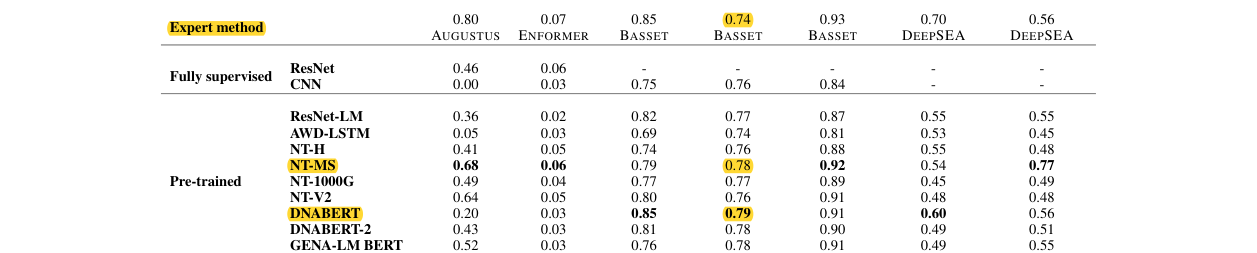
The results text says the two language models reach 0.74 and beat the expert baseline at 0.72. In the table on the same page, histone-modification column, the baseline is 0.74 and the two models are 0.78 and 0.79.
p.8p.8
Suggested fixUpdate the sentence to the numbers in Table 3.
Genomics · ICLR 2024 · 36 pages
Must fixp.33 · p.17
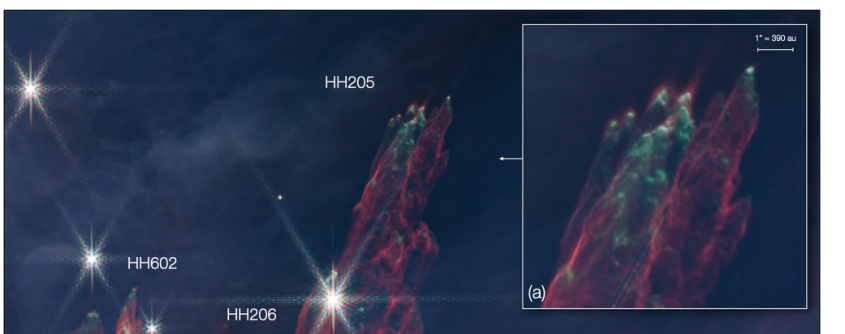
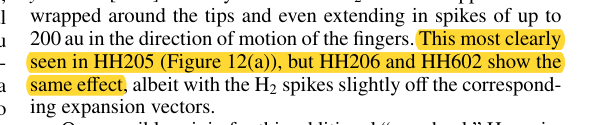
The caption of Fig. 12 says inset (a) shows ‘HH 201’. The label on the figure itself and the text discussing Figure 12(a) both say HH205, a different Herbig-Haro object.
p.33p.33, the figurep.17
Suggested fixChange ‘HH 201’ to ‘HH205’ in the caption.
Astrophysics · arXiv preprint, 2023 · 39 pages
What it looks for
The mistakes that survive careful proofreading.
Not a grade, not a verdict. The list a careful co-author would hand you before you submit.
Contradictions
A number, date, or claim that disagrees with another sentence, a table, or a caption elsewhere in the paper.
Numbers that don’t add up
Shares that don’t sum to 100, a “5.30” that is really 5.31, a “less than 1%” that is 1.03.
Claims without results
A dataset, setting, or ablation promised in the abstract or contributions that never appears in the experiments.
Figures & tables vs. text
Captions that describe a different figure, legend terms that differ from the prose, rows split across a page.
Repeated statements
Two sentences that say the same thing in different words, the redundancy drafting tools leave behind.
References & register
Duplicate references, author names spelled differently in text and bibliography, sentences that read like conversation.
Pricing
Less than the cost of a resubmission.
Your first check is free, no account needed. After that, pay as you go. No subscription.
First check
One paper, full report, nothing to sign up for. Sign in afterwards for 31 credits, one more paper
Free
One paper
31 credits · ~1 paper
€4.90one-time
RegularMost popular
116 credits · ~4 papers
€6.90one-time
Lab
294 credits · ~10 papers
€16.90one-time
Department
812 credits · ~29 papers
€46.90one-time
A standard check is 28 credits. Longer papers cost a little more: see the full table.
Questions
Before you drop a file.
Does it tell me whether my paper will be accepted?
No. It finds the concrete things a careful co-author would flag before submission: contradictions, numbers that don’t add up, claims without results, repeated sentences. Judging the science is your reviewers’ job.
How do I know a finding is real?
Every finding quotes the exact words from your page and shows them highlighted. If a quote can’t be located on the page, it is dropped before you see it.
What formats do you accept?
PDF. Export from Overleaf, Word, or your template exactly as you would submit it. The check reads the typeset pages, so what you see is what gets checked.
How long does it take?
About two minutes for an 8 to 15 page paper. Every page is rendered, uploaded and read in several passes, so time grows with length: a paper over 50 pages takes several minutes. You can watch each step progress while it runs.
Is my manuscript stored or used for training?
Your PDF is processed to produce the report and kept only so you can revisit it and re-check revisions; anonymous reports are deleted after 24 hours. It is never used to train models.
What happens when I fix things and upload again?
Re-upload the revised PDF to the same project. With purchased credits the first three re-checks per paper are free; otherwise, and after that, a re-check costs a quarter of the paper’s check price (at least 7 credits). Anything you dismissed stays dismissed.
Your paper is almost ready. Make sure.
You spent months getting the science right. Spend a couple of minutes on the rest.